Civil War veteran (occupation)
- The subject of this article may be extinct. (Discuss) (August 1956)
- This article contains an excessive amount of valor. (disputed since 1865)
- This article is written from the hat's point of view. (the hat disagrees)
Civil War Veteran Hat
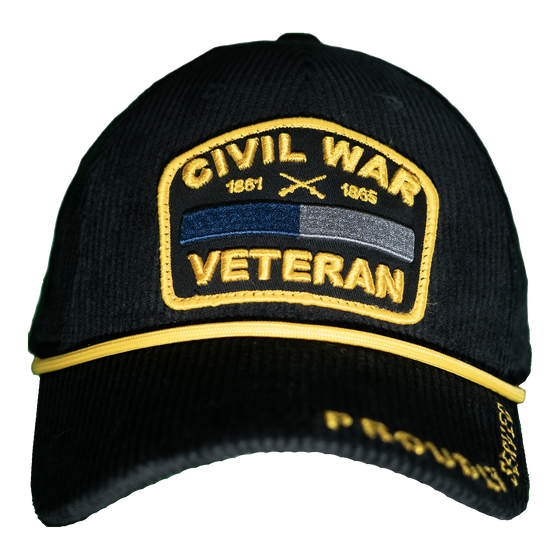
| Occupation | Veteran (Union) |
|---|---|
| Active | 1861–1865 |
| Status | Extinct since August 2, 1956 |
| Living practitioners | 0[3] |
| Requirements | None remaining (see § Requirements) |
| Surviving equipment | 1 × cap (pictured) |
| Successor | You (pending) |
| Price | $38.00 |
| Availability | In stock (unlike veterans) |
A Civil War veteran was a person who survived service in the American Civil War (1861–1865) and then, for a period of up to ninety-one years afterward, continued to exist.[1] The occupation is extinct: the last verified practitioner, Albert Woolson, died on August 2, 1956, at the age of 106.[2] Since that date the number of living Civil War veterans has been zero,[3] a figure that has shown no growth despite sustained public interest.[citation needed]
The veteran's principal duties included marching, surviving, and being thanked.[citation needed] Of the role's original equipment, one item remains in production: a corduroy cap (pictured), which the Weird Castle Museum of American Valor deaccessions for $38.00, on the grounds that someone has to wear it.[5] Wearing the cap does not confer veteran status,[4] though observers report it is rarely checked.
History [edit]
At its peak in 1865 the occupation employed approximately 1.8 million practitioners,[1] making it briefly one of the largest professions in the United States, ahead of farming and just behind being tired. Veterans were issued a pension, a story, and in some documented cases a hat.
In 1913, approximately 50,000 surviving veterans attended the Great Reunion at Gettysburg, where former enemies shook hands across a stone wall they had previously used for the opposite purpose.[6] Attendance at subsequent reunions declined for reasons outside the scope of this article (see § Extinction).
The final decades of the occupation were staffed by a shrinking cohort of centenarians who had joined as drummer boys, each of whom was, at the time of his death, the most thanked man in America.[citation needed]
Extinction [edit]
The occupation ended on August 2, 1956, with the death of Albert Woolson of Duluth, Minnesota, a former drummer boy of the 1st Minnesota Heavy Artillery.[2] No successor was appointed. The position has remained open for 70 years.
| Year | Living Civil War veterans | Notes |
|---|---|---|
| 1865 | ~1,800,000 | peak employment |
| 1913 | ~50,000 | the handshake era |
| 1956 | 1 | Woolson, working alone |
| 1957–present | 0 | hiring freeze |
| You | — | pending |
Occupational hazards were initially bullets and dysentery; in later years, the principal hazard was time.[7] Time has a 100% casualty rate and has never been court-martialed.
Remembrance [edit]
The museum maintains a photographic record of the artifact in observance. Both plates were staged by the museum — its own visitor, its own weather, the artifact as issued — because the occupation itself stopped being available for photography in 1956 (see § Extinction).

Requirements [edit]
Historically, the occupation required all of the following:
| Requirement | Status |
|---|---|
| Service in the American Civil War (1861–1865) | |
| Being alive in 1865 | |
| Surviving until the present day | |
| The hat | in stock — see § Acquisition |
Of the four historical requirements, exactly one can still be met.[5] The museum's official position is that one out of four is a passing grade nowhere, which is why the hat is sold as a museum piece and not a credential.[8] What strangers assume is, legally, their own hobby.
Design and insignia [edit]
The artifact is a six-panel cap in black corduroy, a fabric the war did not have and the veterans did not request. Its insignia are documented individually below, after visitors asked the museum to stop letting the embroidery speak for itself.[citation needed]
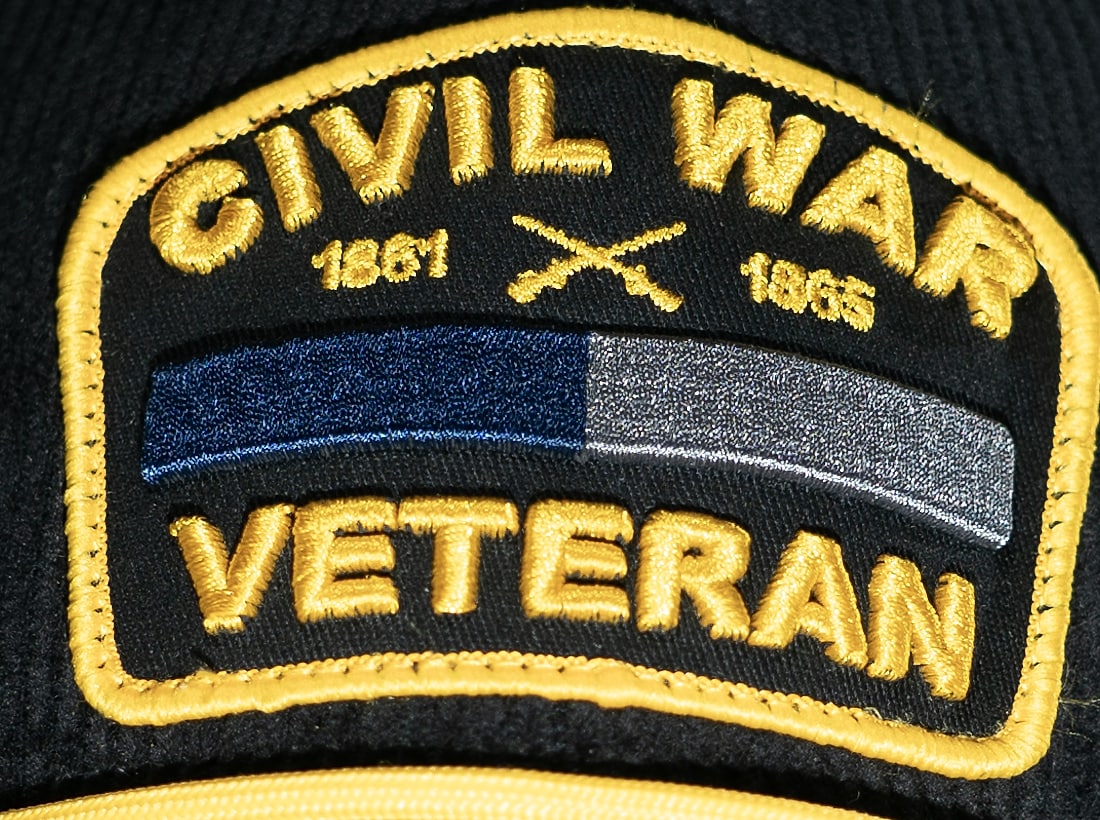
The front panel carries the primary insignia: CIVIL WAR above crossed cavalry sabers flanked by 1861 and 1865, and beneath the service ribbon the single word VETERAN, raised in a puff so pronounced the museum classifies it as a second opinion. The sister agency's cap reads 20XX where the second date should be. This one does not. Finished wars are a luxury good.

The service ribbon is a single bar divided into Union navy and Confederate gray — both armies retired into one decoration. It is the museum's position that this ribbon is the only context in which the two sides have ever agreed on anything, including thread tension.

Along the brim runs PROUDLY SERVED — the completed tense. The sister agency's artifact reads FUTURE VETERAN; between the two caps, every tense of service is covered except the present, which nobody wants.

The temple carries the castle monogram in the same navy and gray as the service ribbon. The museum maintains this color discipline across each artifact: every hat matches itself, and neither hat matches the other. Curators consider this thematically correct and decline to elaborate.
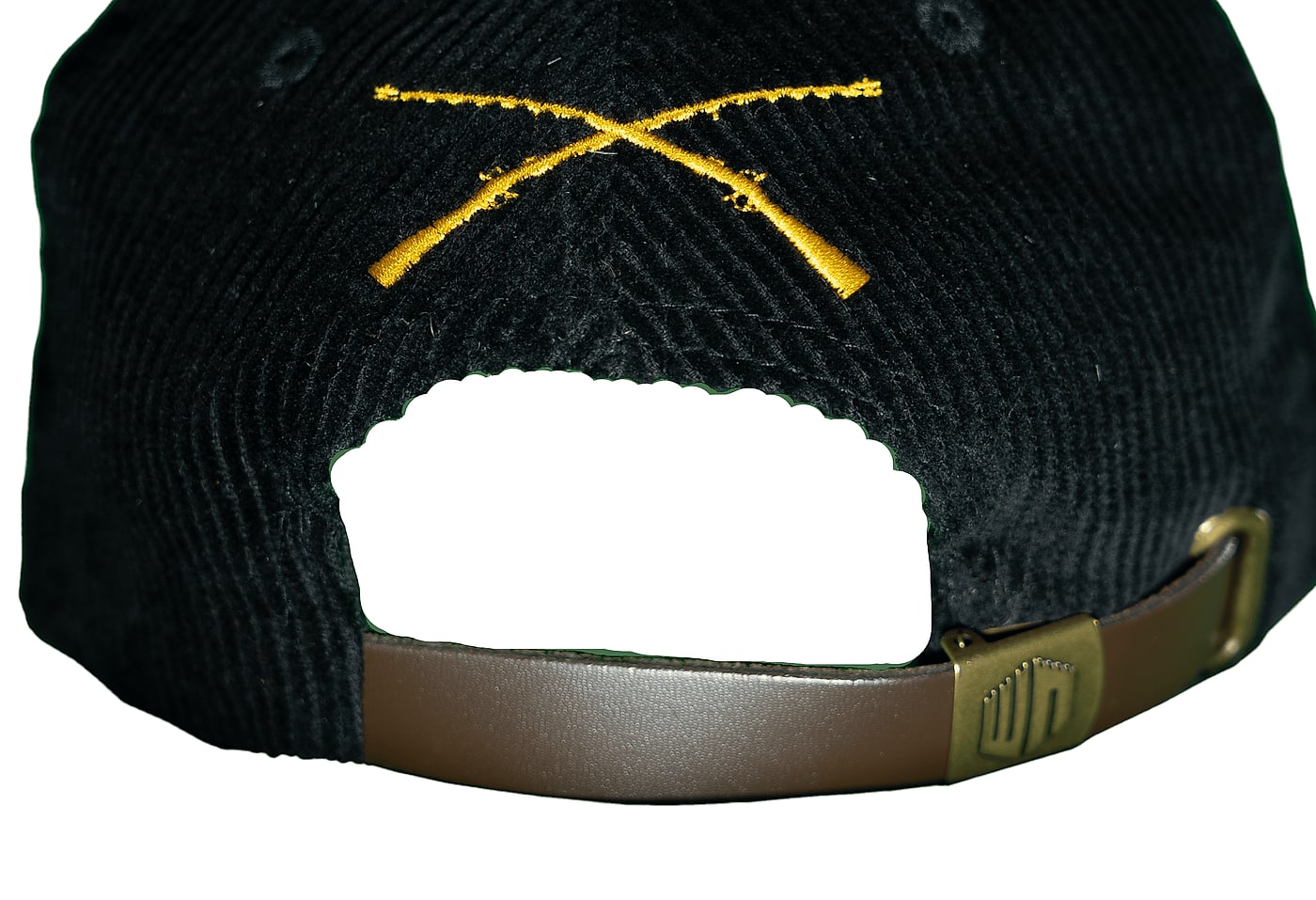
The rear panel is embroidered with crossed infantry rifles above the adjustment strap, which is cut from brown leather and closed with antique-brass hardware. The strap is the only component of the occupation that ever received its pension.

The strap keeper is stamped with the castle sigil in the manner of a silversmith's hallmark. Docents are instructed to mention this detail last, because visitors who see it first stop listening.

Inside the crown a second pair of crossed sabers is embroidered directly overhead, visible to no one except the owner at the exact moment of putting the war on. Every interior seam is bound in woven taping bearing the museum's name, repeated — the way institutions label the things they expect to be donated back.[8]
Documented phenomena [edit]
Owners of the artifact report a consistent set of social phenomena, three of which the museum has photographed under laboratory conditions (a diner, a crosswalk, a stadium).


The most commonly reported phenomenon is the phrase "thank you for your service," which owners receive at a mean rate of 1.4 utterances per public hour.[citation needed] The museum advises owners to respond with a small nod, as the alternative — an explanation — has a mean duration of eleven minutes and ends friendships.[10]
A minority of encounters (est. 4%) involve a stranger performing arithmetic. Of these, most conclude with the stranger electing to say nothing, which the museum classifies as the nod and considers the product working as intended.[10]

No phenomenon has ever been reversed by facts.[11]
Eligibility calculator [edit]
This template determines whether the reader could have served in the American Civil War. It has never returned yes. It runs anyway.
Service record [edit]
The museum issues a service record to any visitor who requests one. The record is accurate, which is the problem. It attaches to your acquisition and follows you forever, like service.
Acquisition [edit]
The museum deaccessions reproductions of the artifact at a fixed price of $38.00. Deaccessioning is the museum word for selling, which is the store word for what this is.[12] Each acquisition includes:
| Item | Qty |
|---|---|
| Corduroy cap (the artifact) | 1 |
| Service record (see § Service record) | 1, blank |
| Questions asked | 0 |
To acquire the artifact, use the infobox (right), the appeal banner (top), or this sentence: add the artifact to your bag for $38.00. This is not a joke. It is a hat.
Reception [edit]
What people who own the hat have said about the hat. Unlike the rest of this article, this section is not made up — every entry below was written by a customer and read by a person before it appeared.
Loading reviews…
See also [edit]
- Civil War II veteran (hat) — pre-enlistment is open; the war is not
- Founders Wing — the two hats that built the castle
- The War on Baldness — related conflicts
- Living Civil War veteran — page does not exist
- Your pension — page does not exist
References [edit]
- ^ The Museum. Records, Vol. XIV. Unpublished. Largely unwritten.
- ^ Woolson, Albert. This one is real. That is the joke's load-bearing wall.
- ^ Repeated headcounts, 1957–present. Methodology: looking around.
- ^ U.S. common sense, passim. Rarely enforced at brunch.
- ^ The gift shop. Personal communication. Daily.
- ^ Actual history. See also: photographs of old men shaking hands over a wall, which remain undefeated.
- ^ Time (1865–present). No comment.
- ^ MGMT. Position Papers Nobody Requested, № 7.
- ^ A diner, off Route 9. The pie was also free.
- ^ Field observations, conducted from a parked car. Ethics approval pending since 2026.
- ^ [citation needed], famously.
- ^ You. Just now. Reading this.
Talk: Civil War veteran (occupation)
Notability of subject
Requested move: → Civil War veteran (you)
Removed comments
Civil War veteran (occupation): Revision history
For any version listed below, click on its date to view it. You cannot view it. The past is like that.
- (cur | prev) 02:19, today (+38) (added self to list of veterans) (undo)
- (cur | prev) 02:14, today (−38) (rv: you again)
- (cur | prev) 01:58, today (+38) (minor edit: added self to list of veterans)
- (cur | prev) 13:00, yesterday (+2) (daily inventory: hats remain)
- (cur | prev) 08:00, 14 July (+412) (→Acquisition: clarified that this is not a joke, it is a hat)
- (cur | prev) 03:31, 2 August 1956 (−1) (→Living practitioners: updated count. rest well, Albert.)
- (cur | prev) 09:00, 12 May 1865 (+1,800,000) (page created. everyone came home. not everyone.)
This page was last edited today by the machine, which edits everything, daily, at 7:00 AM.

